How to Use a Penis Pump in the UAE: What It Does, Pressure Limits and Safety
 Intimate UAE Editorial
- 10 Nov, 2026
- 15 min read
Disclosure: Intimate UAE and adulttoysuae.com are run by the same team. Our guides are written around materials, specifications and care information we can verify, not around what the store wants to sell; where we link to it, those links are marked as sponsored.
TL;DR: A penis pump works by drawing air out of a sealed cylinder, which lowers the pressure around the penis and pulls blood into it. Two things decide whether it’s safe: the pressure, which should never be painful, and the session length, which should stay short. Discomfort, numbness or discolouration mean stop immediately. This guide covers the mechanics, the two limits, and when to ask a doctor instead.
This is an educational guide about using a product. It is not medical advice, it makes no claim about treating any condition, and it is not a substitute for seeing a doctor.
The two numbers that matter
Everything else in this guide is detail. These two decide whether a session is safe:
| The number | Safe approach | Why |
|---|---|---|
| Pressure | Only as much as feels like gentle suction. Never painful. | Pain is the signal that tissue is being stressed. Numbing yourself to it removes your only warning. |
| Session length | Short — a few minutes at a time, with breaks | Tissue needs circulation. Long unbroken sessions are where most problems start. |
The rule that covers both: if it hurts, if anything goes numb, or if the colour changes, stop and release the pressure. Those three signs are not “a bit much” — they’re the body saying the limit was already passed.
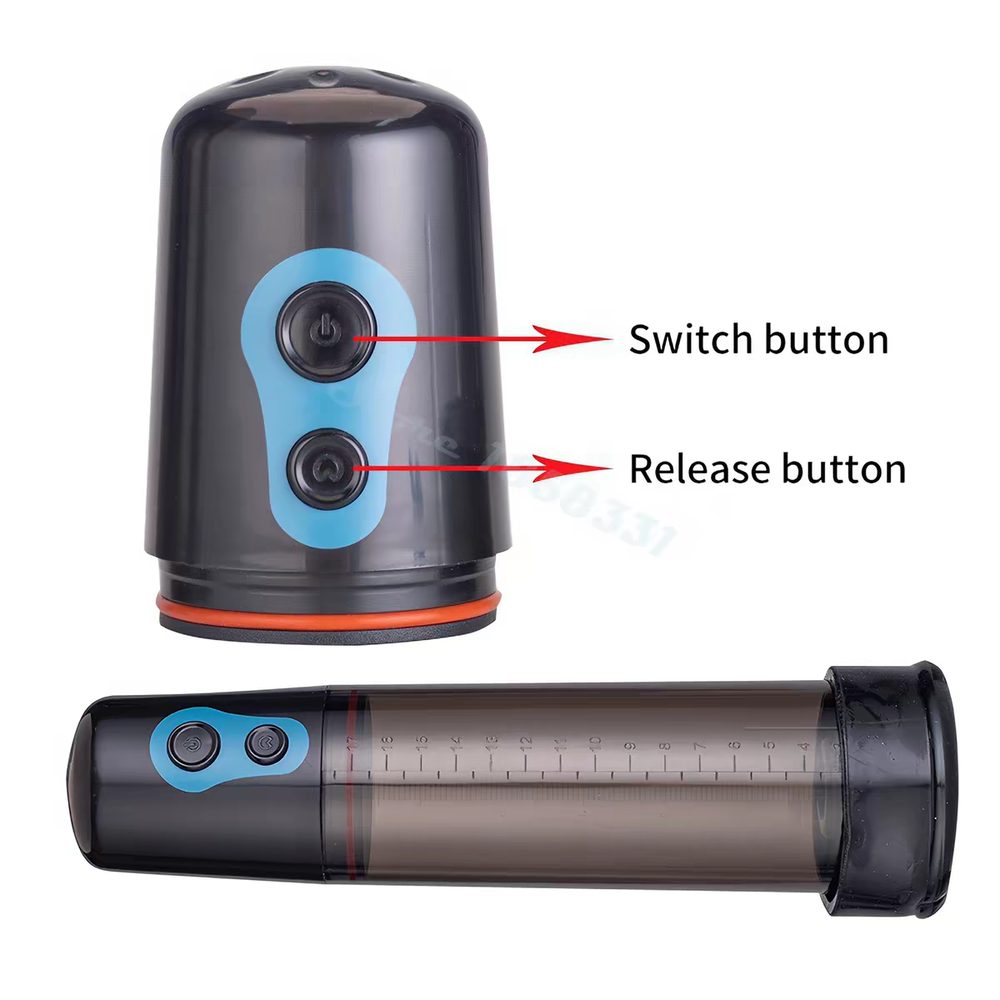
This is why a gauge matters more than it sounds: without one you are judging pressure by feel alone, and feel is exactly what your body stops reporting reliably once something is wrong. The vacuum pump with a graduated scale is the type that shows a reading you can watch and stop at, rather than a tube you squeeze until it feels like enough.
How a pump actually works
A pump is a cylinder that seals against the body, plus a mechanism for removing air from inside it.
- The cylinder creates the sealed space. It has to fit well enough to hold a vacuum — too wide and it won’t seal, too narrow and it’s uncomfortable at the base.
- The pump mechanism — usually a hand bulb or a trigger grip — draws air out.
- The valve releases the pressure. Every pump has one, and it is the part you need to be able to reach instantly during a session.
- The gauge, on models that have one, shows how much vacuum is being applied. This is why a graduated or scaled model is easier to use carefully: without a gauge, you’re judging by feel alone.
Why a gauge matters: it turns “that feels like enough” into a number you can keep the same or lower next time. Most injuries from pumps come from more pressure than intended, not less.
What the cylinder is actually doing to tissue
The mechanism is worth understanding because it explains every rule that follows.
Removing air from a sealed cylinder lowers the pressure inside relative to the body. Blood flows toward the lower-pressure area, so the tissue inside the cylinder engorges. That is the entire effect: a pressure differential causing temporary vascular congestion. Nothing is stretched permanently, and no tissue is “trained”.
Three consequences follow directly from that mechanism.
The effect is bounded by circulation, not by pressure. Once the tissue is engorged, more vacuum does not produce more of anything — it produces pressure on the same tissue. This is why the sensation plateaus and why continuing past that point adds risk rather than result.
The tissue cannot report damage while it is happening. Under vacuum, nerve signalling in the area becomes less reliable. Numbness is a late symptom, not an early warning, which is why “stop before it feels like much” is a rule rather than a preference.
Recovery time is vascular, not muscular. The soreness afterwards comes from capillaries that have been distended. They recover on a scale of hours to a day, not minutes, which is why back-to-back sessions compound rather than accumulate benefit.
Understanding that sequence is what makes the practical limits — short sessions, low pressure, rest between uses — look like the method rather than the paperwork.
Doing it properly, from set-up to finish
Before you start
- Learn where the release valve is and how it feels to open it, before the pump is anywhere near your body. Do this with the cylinder empty.
- Check the seal. The base of the cylinder needs to sit against the body with no gaps. A little water-based lubricant around the rim helps it seal.
- Trim any hair at the seal line. It’s the most common reason a pump won’t hold pressure.
- Pick somewhere you can stop immediately and won’t be interrupted.
- Set a timer for a short session. “A few more minutes” is exactly how sessions run long.
The session itself
- Apply lubricant to the base of the cylinder, and to yourself. This helps the seal and reduces friction at the rim.
- Place the cylinder so it sits comfortably, with the base flat against the body.
- Create the seal by holding it in place.
- Pump slowly. One squeeze, then pause. Feel what changed before adding more.
- Stop well before it feels tight. The right amount is less than you expect. If you’re using a gauge, note the reading and stay at or below it next time.
- Hold briefly, then release. A short hold with the valve opened is the whole session.
- Open the valve before removing anything. Releasing the pressure first is what makes removal comfortable.
- Rest between sessions. Tissue needs time between uses; back-to-back sessions are the fastest route to soreness.
How long, and how much pressure
The honest answer to both questions is “less than the internet says”, but vague advice is what sends people looking in the first place, so here is what the practical guidance converges on.
Session length. Short holds, not long ones. The commonly cited starting point is five to ten minutes per session, with the pressure released and re-applied rather than held continuously. Nothing about a longer session produces a better result — the effect is vascular and it plateaus quickly. If you are going past fifteen minutes because it still feels like something is happening, what is happening is tissue stress.
Pressure. Pumps sold for personal use either have a gauge or they do not. If yours does, stay at the low end of what the gauge shows and treat any discomfort as a ceiling, not a target. If it does not — and most inexpensive cylinders do not — the rule is a physical sensation rather than a number: you should feel a gentle pull, never a stretch or a throb. A pump that requires real effort to squeeze is telling you the seal is already at the limit.
Frequency. Not daily. The tissue needs to recover between sessions, and the people who run into trouble are almost always the ones who used it repeatedly in one sitting rather than the ones who used it once carefully.
The four things people get wrong
These come up repeatedly enough to be worth naming before the safety section.
Chasing the pressure. Pumping until it is uncomfortable, because the “full” feeling is the point being sought. The sensation peaks early; everything after that is cumulative strain on tissue that cannot signal damage clearly while it is happening.
Skipping the release. Holding pressure for a long block instead of short cycles. Releasing is not a formality at the end — it is part of the method, because it lets circulation recover between draws.
Ignoring the base. A cylinder that does not seal properly at the base does not just work badly, it concentrates pressure at the rim. Poor seal plus high effort equals a ring of bruising that appears the next day.
Treating it as a measurement. Using the pump to establish “how big it actually is”. The size under vacuum is not a meaningful figure — it is a temporary state produced by pressure, and comparing it to anything else is comparing two different conditions.
What to expect — and what it isn’t
What a session does: temporarily draws blood into the area, which makes it look fuller for a short time.
What it doesn’t do: it doesn’t create a permanent change, and a single session’s effect fades within a short while. Anyone selling a pump on the promise of a lasting result is overstating it — that’s a claim about a medical outcome, and a pump isn’t a treatment.
This matters for choosing one: buy a pump for how it feels to use, not for a promised result it can’t deliver.
Stop immediately if
| Signal | What to do |
|---|---|
| Sharp or persistent pain | Open the valve, stop |
| Numbness, tingling or loss of sensation | Open the valve, stop |
| Discolouration — blue, purple, or blotchy | Open the valve, stop |
| Blisters, bruising or broken skin | Stop, and let it heal fully before any further use |
| Dizziness or feeling faint | Open the valve, lie down, stop |
| The pressure won’t release | Stop and address the valve before anything else |
If a symptom doesn’t settle quickly, or comes back, that’s a question for a doctor rather than for a product guide.
What “doesn’t settle quickly” means in practice
Vagueness here is what makes people either panic unnecessarily or wait too long, so it is worth being specific about which symptoms are ordinary and which are not.
Ordinary, and expected to pass within minutes of releasing pressure: a temporary feeling of fullness, slight redness at the seal line, and a brief sensitivity afterwards. These are the direct consequence of what the device does and they resolve on their own.
Expected to pass within a day, but worth not repeating: a ring of mild bruising at the base, or a dull ache that fades over hours. This usually means the seal was poor or the session ran long. It is not an emergency, but it is the device telling you the session was over the limit — repeat it and the next one will be worse.
Not ordinary, and a reason to stop using it and speak to a clinician: blistering or broken skin, numbness that has not fully returned within an hour or two, discolouration that persists after pressure is released, any sharp pain during rather than after, or a return of the same symptom on a subsequent session at lower pressure.
The last one matters most. A symptom that appears at the same point every time, no matter how careful you are, is not a technique problem — it is a signal that something about your anatomy or circulation does not suit this device, and no adjustment to the routine will change that.
The claims you will see, and what they are worth
Search for a pump and you will find three claims repeated. It is worth knowing where each one stands, because two of them are not supported and one is true only in a narrow sense.
“It increases size permanently.” This is the claim that sells pumps and it is not supported. The visible change is a temporary vascular effect that resolves within hours. Nothing about vacuum pressure causes lasting tissue growth, and any product marketed on this promise is overstating what the device does — a claim about a medical outcome that a consumer product cannot deliver.
“Doctors use it for erectile dysfunction.” This one has a real basis. Vacuum therapy is a recognised clinical option, typically prescribed and fitted by a clinician for specific patients, and it is used alongside a constriction ring under medical supervision. The gap between that and a consumer pump used recreationally is the fitting, the supervision, and the assessment of whether it is appropriate for you at all. A clinical device being real does not make a random cylinder equivalent to it.
“It helps with stamina or training.” No meaningful evidence base. It is not harmful as a claim, but it is a benefit that has not been demonstrated, and treating an unproven benefit as a reason to use it more often is how sessions get longer than they should.
The practical conclusion: buy a pump for what it does in the moment, if that is something you want. Do not buy one as a treatment, and do not use it to pursue an outcome it cannot produce — that is exactly the mindset that leads to longer sessions and higher pressure, which is where the risk actually lives.
⚠️ When not to use one
Skip it and speak to a doctor instead if any of these apply:
- You have a bleeding disorder, or you take blood-thinning medication.
- You have a condition affecting the area, or you’re recovering from surgery or an injury there.
- You’re experiencing pain that hasn’t been assessed.
- You’re concerned about sexual function or fertility — that’s a medical conversation with a real clinician, not a product decision.
None of those are reasons to be embarrassed about asking. They’re ordinary reasons to get an ordinary answer from someone qualified to give it.
Cleaning and storage
- Wash the cylinder with warm water and mild soap after each use, and dry it fully — inside as well as out.
- Clean the valve and any tubing according to the manufacturer’s instructions. This is the part people skip, and it’s the part that degrades first.
- Store it disassembled and dry. A cylinder stored sealed and damp is where odours come from.
- Don’t share it without cleaning it properly between users — it’s a body-contact product like any other.
Our cleaning guide covers the material-by-material routine, and the materials guide explains why non-porous surfaces clean fully and porous ones don’t.
The parts that degrade first
A pump has more failure points than a dildo, and they fail in a predictable order.
The seal ring or sleeve goes first. It is the softest component and the one in constant contact with lubricant, which is why silicone-based lubricant will shorten its life dramatically — it degrades silicone rubber. Use water-based lubricant even if the cylinder itself is silicone. Our lubricant guide covers which base suits which material, and which combinations you should avoid entirely.
The valve is second. Residue collects in the mechanism, and a valve that sticks is a valve that does not release when you need it to. Flush it with warm water after each session rather than waiting for a visible problem.
The tubing, on models that have it, is where mould appears if it is stored wet. Detach it, drain it, and hang it to dry rather than coiling it damp.
The gauge, where fitted, is sealed and not user-serviceable. If a reading stops returning to zero when released, the gauge has failed and you no longer have the information the whole method depends on — replace it rather than continuing to guess.
A cylinder that has developed a crack or a cloudy, pitted interior should be replaced. Cloudiness in clear plastic is the material degrading, and a degraded surface does not clean fully; the same applies to a seal ring that has gone tacky or lost its shape.
Storage that does not cost you a replacement
Store it disassembled and dry, in something that lets air move. A sealed bag traps residual moisture against the seal ring, which is precisely the component you least want sitting wet.
Keep it away from other silicone items if the seal is silicone — silicone against silicone can bond over time and leave a tacky, degraded surface on both. A cloth bag or a hard case with the parts separated solves this without effort.
Sources and further reading
- Erectile dysfunction — MedlinePlus, US National Library of Medicine — the clinical picture of erection problems, and why a pump is a device rather than a treatment.
- Penis pump — MedlinePlus medical device information — what a vacuum device is indicated for and the safety limits clinicians describe.
- Penile erection — MedlinePlus medical encyclopedia — how blood flow produces an erection, which is the mechanism the pump borrows.
- Pain — MedlinePlus — the general principle that pain is a stop signal, not a threshold to push past.
Key takeaways
- A pump changes blood flow temporarily; it does not produce a permanent change in size, and no device does.
- Pressure should never reach the point of pain. Discomfort, numbness or discolouration are stop signals, not a stage to work through.
- Keep sessions short. The two numbers that matter are pressure and time, and both have a low ceiling.
- A pump is not a treatment for erectile dysfunction. If erections are a persistent concern, that is a conversation with a doctor.
- Skip it entirely if you have a bleeding disorder, are on blood thinners, or have a condition affecting the penis — ask a clinician first.
Frequently asked questions
How much pressure is safe?
Only as much as feels like gentle suction, and never enough to hurt. If your pump has a gauge, pick a reading that’s comfortable and stay at or below it. Pain, numbness or discolouration mean the limit was already passed — release the pressure.
How long should a session be?
Short, with breaks, and shorter than you’d guess. Set a timer rather than judging by feel — “a few more minutes” is how sessions run long.
Does it give permanent results?
No. A session temporarily draws blood into the area and the effect fades. Anyone promising a lasting change is making a medical claim a pump can’t support.
What if the pressure won’t release?
That’s the situation to stop and solve before anything else — check the valve. Every pump has a release mechanism, and knowing how to work it is the first thing to learn.
Can I use it if I’m on medication?
Ask a doctor. Blood-thinning medication and bleeding disorders in particular are reasons not to use one without medical advice.
Do I need lubricant?
A little water-based lubricant around the rim helps the seal and reduces friction. It’s also the only type safe with a condom.
Why does my pump keep losing pressure?
Usually the seal — hair at the rim, a gap at the base, or a cylinder that’s too wide. Trimming and repositioning fixes most of it.
Should I use it with a condom?
If you’re sharing it, yes, and clean it between users regardless. It’s a body-contact product, so the cleaning rules are the same as any other.
What size cylinder do I need?
One that seals at the base without pressing anywhere. Measure your erect girth and pick a cylinder comfortably wider than that — too narrow concentrates pressure at the rim, which is where bruising comes from. Too wide simply fails to seal, and a cylinder that will not hold vacuum is the most common reason a first attempt does not work at all.
How often is too often?
There is no published daily allowance, but the useful rule is about recovery rather than frequency: if the previous session left any bruising, ache or numbness, wait until it has fully gone before using it again. People who run into problems are usually the ones who used it several times in one sitting, not the ones who used it once a week.
Can it make things worse over time?
Not through normal careful use, but the two mechanisms that cause trouble are both about overdoing it rather than the device itself: sustained high pressure, and repeated sessions without recovery. Both are self-inflicted and both are avoidable, which is why the pressure and time limits in this guide matter more than the model you choose.
Does it work if I have erectile difficulties?
That is a question for a clinician, not a product guide, and the honest answer is that vacuum therapy is a real clinical option that requires assessment first. Using a consumer pump as a self-treatment for a medical concern skips exactly the step — a professional assessment of whether it is appropriate for you — that makes the clinical version safe.
The bottom line
Two limits decide everything: pressure that never hurts, and sessions that stay short. A model with a gauge makes the first one easier to hold to, and a timer makes the second one automatic. Anything that hurts, numbs or discolours means stop — that’s the whole safety system, and it is a genuinely simple one to follow.
The pattern behind every mistake in this guide is the same one: treating a device that produces a temporary effect as if it were a treatment for a permanent goal. People do not get hurt by using a pump carefully. They get hurt by using it longer, harder and more often in pursuit of something it was never going to deliver. Use it for what it does in the moment, give the tissue time between sessions, and the risk stays where it belongs — small enough to be managed by paying attention.
If privacy is the part you’re unsure about, how discreet delivery works in the UAE walks through the box, the billing line and the courier handover — and the complete buying guide covers how to compare any listing before you order.
Intimate UAE is an educational, judgement-free guide. This is not medical advice.
This is general information, not legal advice.
Explore our store
Visit adulttoysuae.com to view the linked page.
We run this store as well as this guide — links are marked sponsored.