Comparing Couples Toys in the UAE: What Works for Two People
 Intimate UAE Editorial
- 11 Oct, 2026
- 8 min read
- Last updated 28 Oct, 2026

Disclosure: Intimate UAE and adulttoysuae.com are run by the same team. Our guides are written around materials, specifications and care information we can verify, not around what the store wants to sell; where we link to it, those links are marked as sponsored.
TL;DR: A toy works for two people when it doesn’t need a hand to hold it, doesn’t need a manual mid-session, and doesn’t disturb anyone through a shared wall. In the UAE they broadly sit in two bands (checked October 2026): roughly AED 250–340 for a simple wearable or ring, and AED 330–450 for an app-controlled wearable. This guide compares couples toys on those features — fit, control, material, noise and price band — rather than ranking them.
Start with the situation you’re in
The framework below compares on fit, control, material, noise and price. This table gets you to the right shape first.
| If this is you | Look at | Why it works for two | Check on the listing |
|---|---|---|---|
| Neither of us wants to hold it | A hands-free wearable | Nobody is operating a device instead of participating | How it stays in place |
| We’re long-distance | The App-Controlled Couples Vibrator | One person can control it from anywhere | Whether one remote works for both |
| We share walls with neighbours | Anything rated quiet | Discretion matters more than intensity here | The stated noise level |
| One of us is new to this | The Vibrating Cock Ring | The gentlest shared start, and simple to use | Fit, since a ring has to be the right size |
| We want one thing that does both | A rabbit-style model | Internal and external stimulation at once | Whether both parts run independently |
| Body-safe material matters most | Materials guide | Silicone vs TPE, and why sharing changes the answer | Non-porous silicone if you’ll share it |
| Still working out how to raise it | Talking about it | Scripts for the conversation before the purchase | — |
Why couples toys are compared differently
A toy for one person is judged on its own merits. A toy for two adds three constraints that have nothing to do with features:
- Hands-free or held? If one partner has to hold it, that partner is working rather than participating.
- How is it controlled? A button on the device means someone has to reach for it; a phone or a second controller changes who can steer.
- How loud, and how storable? A shared wall or a shared home raises the cost of noise and of anything hard to put away.
None of these are opinions, and all of them are discoverable from a listing once you know what to look for. That’s the point of comparing by feature rather than by ranking.
If you haven’t settled whether you want something external or internal, our external vs internal vibrators comparison is a useful read first. And if raising the subject at all feels like the harder part, our guide to building intimacy as a couple covers that conversation directly.
The five things worth comparing
1. Fit — wearable or hand-held
This is the feature that decides whether a toy actually gets used together. A wearable stays in place on its own, so neither partner has to hold it and it can stay put during sex. A hand-held toy is fine for solo use but needs someone to operate it in a shared setting.
What to look for: whether the listing describes it as wearable, and whether the shape (a U-shape or a ring, for example) is designed to sit against the body rather than be gripped.
2. Control — on-device, remote or app
Control is the second thing two people notice. An on-device button means whoever holds it also steers it. A remote or app lets control sit in either partner’s hand, and — with an app — it can be handed back and forth, or passed across distance.
What to look for: how the settings are changed. App control adds capability but also pairing and charging to set up in advance, which is worth doing together before the moment rather than during it.
3. Material
The same rule as any toy, with one addition: shared use raises the stakes on cleaning. Silicone is non-porous, easy to clean and the standard for anything shared. TPE is softer and cheaper but porous — it works best with a barrier and needs replacing sooner, which matters more when two people are using it.
Our body-safe materials guide covers the routine, and the silicone vs TPE comparison sets the two side by side.
4. Noise
A wearable that’s quiet enough for a shared wall is a wearable that gets used without a second thought. Smaller wearable vibrators are generally quieter than larger thrusting devices. If a thin wall or a shared flat is part of the picture, size down and treat “whisper-quiet” claims as something to compare rather than trust.
5. Price band
Couples toys in the UAE broadly sit in two bands, checked in October 2026: roughly AED 250–340 for a simple wearable or ring, and roughly AED 330–450 for an app-controlled wearable or a strap-on harness set. A higher price buys functions — app control, a second motor, adjustability — rather than a better experience by default. For how that fits the wider market, our price guide breaks down the ranges.
Applying the framework: a worked example
Say you want something you can both use in the same room, without anyone holding it, and without app setup.
- Fit: wearable — nothing to hold.
- Control: on-device or a simple remote, to skip pairing.
- Material: silicone, for shared-use cleaning.
- Noise: a compact wearable rather than a thrusting device.
- Price: the lower band typically covers this.
A small wearable silicone toy with simple controls is the typical example that meets all five. It’s shown below as a concrete illustration of that filter — not as a recommendation, and not as the “best” of anything.
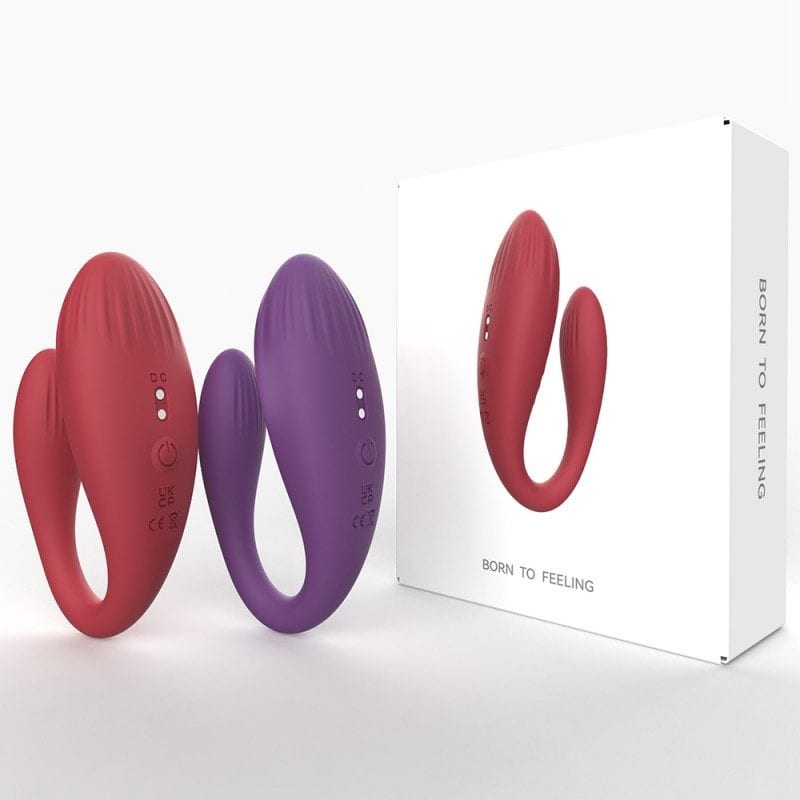
Run the same five steps for the other combinations — long-distance, strap-on play, no-app — and the candidate set builds itself from the product pages.
The shape families you’ll see
- Wearable U-shape. Sits against the body hands-free. The most common shared design, and usually the quietest.
- Vibrating ring. The simplest shared option — nothing to pair, nothing to learn. Our couples toys overview compares this starting point with wearables.
- App-controlled. Control sits in a partner’s hand, in the same room or across distance. Needs setup in advance.
- Rabbit / dual-stimulation. Two motors, one for each zone, adjustable separately. Suits two people who want different intensities at once.
- Harness. Adds penetration to shared play; adjustable fits are more forgiving of sizing. There’s nothing to charge, which makes it the most predictable option.
How to bring it up without pressure
The product is the easy part. The conversation is usually the harder one, so keep it low-stakes:
- Open with a feeling, not a link. “I’d like a bit more variety” lands very differently from sliding a product across the table.
- Pick a neutral moment. A walk or a quiet dinner, not the middle of an argument.
- Frame it as an offer, not a request. “Want to try something together?” is easier to answer than “why don’t we use this?”
- Let “not now” be a real answer. If one partner needs time, that’s information, not rejection — the door stays open.
- Start with the lowest-commitment option. A simple wearable is an easier yes than a device with an app and a learning curve.
If the conversation feels bigger than a toy, our guide to building intimacy as a couple covers desire differences and how to talk about them without it turning into a negotiation. If you’re rebuilding closeness after a rough patch, reconnecting as a couple is the calmer starting point.
Sources and further reading
Key takeaways
- A couples toy has to work without a hand holding it, without a manual mid-session, and without disturbing anyone through a shared wall.
- Compare on hands-free fit, noise, control method and clean-up rather than on a ranked list, because which one suits depends on the situation.
- Wearable and ring shapes suit shared play best; anything requiring continuous positioning usually ends up unused.
- App control is the one feature that changes the shape of the experience rather than just adding intensity, because it moves control to the other person.
Frequently asked questions
What makes a toy work for two people rather than one?
Being hands-free, having easy shared control, and staying quiet enough for a shared home. If one partner has to hold and operate it, it tends to get used once and then put away.
Do we need an app-controlled toy?
No. App control is genuinely useful for long-distance, but for two people in the same room a wearable or a simple ring does the job without pairing anything.
How do we choose between a wearable and a ring?
A ring is simpler — nothing to pair, nothing to learn — and suits a first shared experiment. A wearable U-shape stays in place more independently and usually has more setting options.
Are these toys safe to share?
Yes, with basic hygiene. Use body-safe silicone where you can, wash after every use, and put a condom over any porous (TPE) item before sharing it. Our body-safe materials guide walks through the routine.
How much should we spend on a first shared toy?
You can cover a genuinely useful toy in the lower band, around AED 250–340 (checked October 2026); app-controlled wearables sit a little above that. Spend more only when you know which features you actually use. Our price guide breaks down the ranges.
Is it private to order as a couple?
Yes. Orders ship in a plain box with a generic label, and cash on delivery means no card record — which matters if you share an account. Decide together who signs for the parcel and the last bit of friction disappears.
How discreet is the packaging, really?
A plain brown box with no store name as the sender and no product description on the label. The courier doesn’t know what’s inside, and nothing on the outside links the parcel to what you ordered.
What if one of us isn’t keen?
That’s a normal answer, not a verdict on the relationship. Start with the lowest-commitment option, drop the pressure, and revisit it later. Mismatched interest is one of the most common things couples deal with.
Where can we see the options in one place?
The couples toys category on the store lists the available models with their material and features on the page. Minimum order AED 150, with free delivery, with delivery in 1–5 days across the emirates.
The bottom line
The right couples toy is the one that fits how the two of you actually use it: hands-free, easy to control together, quiet enough for your home, and made of a material you’re happy to clean and share. Compare on those five features rather than on a ranking, and the choice becomes a filter rather than a guess.
If you’ve already settled on what you want, the couples toys category lists the available models with their material and features on the page — plain-box delivery and cash on delivery on every order.
Intimate UAE is an educational, judgement-free guide. This is not medical advice.
This is general information, not legal advice.
Explore our store
Visit adulttoysuae.com to view the linked page.
We run this store as well as this guide — links are marked sponsored.