 Intimate UAE Editorial
- 04 Nov, 2026
Sex Toy Sizes in the UAE: How to Read Insertable Length and Diameter
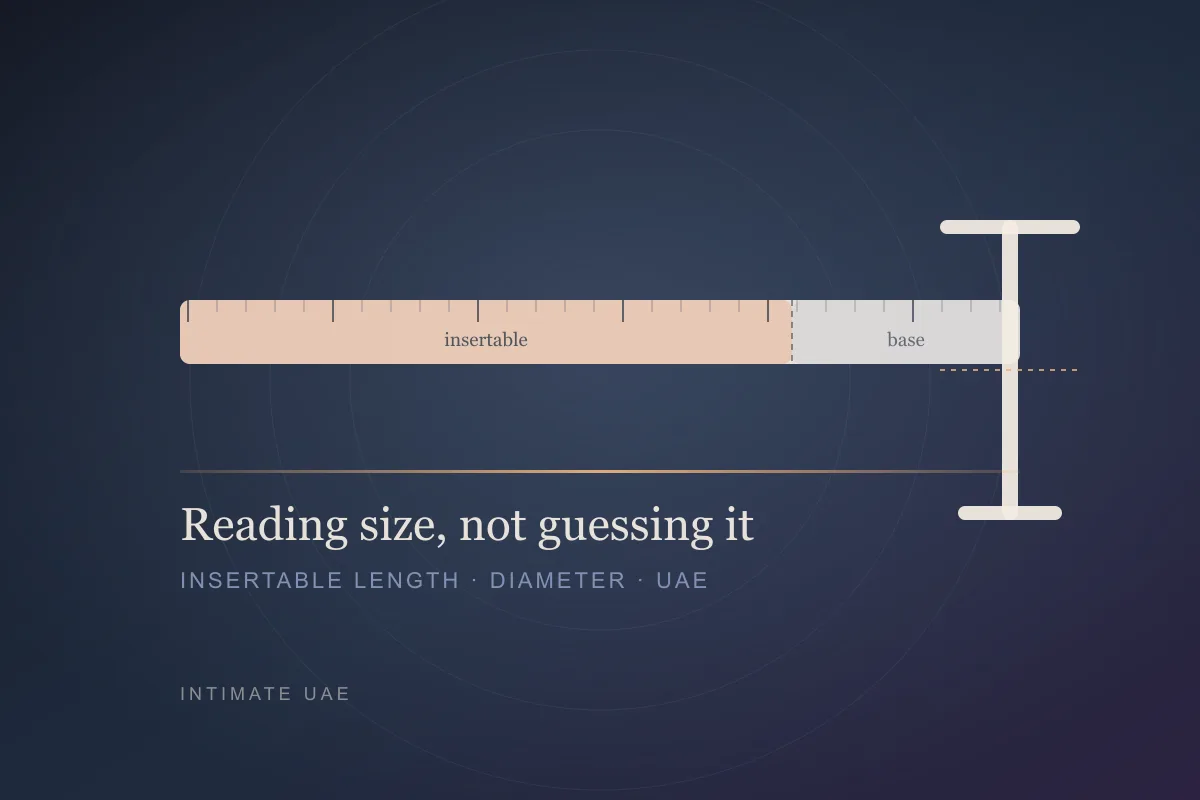
TL;DR: A 2015 study of the sizes listed by eight retailers found most vibrators and dildos sold for vaginal or anal insertion sit between 4 and 6 in (roughly 10–15 cm) of length with a 4–5 in (10–12.7 cm) circumference — around the same dimensions as the average erect penis. In practice, two numbers on a listing decide whether a toy suits you: insertable length, which is not the same as total length, and diameter, which is what girth actually feels like. This guide shows you where to find both, how to convert them without arithmetic, and when the smaller option is the better buy. The two numbers, and why they get confused Most listings give you a size. Very few tell you which size they mean. Three different measurements get published as "length":Total length — tip to the base of the toy, or tip to the end of the handle. This is the number most often printed in a product title. Insertable length — the part that actually goes in, stopping where the shaft meets the base, the testicles, the suction cup or the motor housing. Usable depth — for a male masturbator, the internal channel, which is usually shorter than the case.The gap between total and insertable is not small. In the products we stock it runs from about 2 cm on a dildo to about 5 cm on a large one — enough to turn "18 cm" into 16 cm in use, or to make a 23 cm dildo feel like a 17 cm one. That is why a toy bought on the headline number often arrives feeling bigger or smaller than expected. Diameter is the other half, and it is the one people underestimate. A 1 cm jump in diameter is a much bigger change in sensation than a 1 cm jump in length, because circumference scales with it and the tissue responds to girth. If you only check one figure, check this one. The conversion that stops the arithmetic Listings mix centimetres, millimetres and inches, sometimes in the same listing. Two shortcuts cover almost everything:You want From inches From centimetresDiameter Multiply circumference by 0.318 Divide circumference by 3.14Circumference Multiply diameter by 3.14 Multiply diameter by 3.14Or use the pairs directly: a 30 mm diameter is about 9.4 cm around; 35 mm is about 11 cm; 40 mm is about 12.6 cm; 45 mm is about 14.1 cm. The jump from 35 mm to 45 mm looks like a centimetre on paper and feels like a different category in use, especially for anal play where the same diameter is a bigger ask. Reading a listing that mixes units The awkward cases are the ones where a listing gives circumference in one unit and diameter in another. Two worked examples cover most of them. A toy sold as "1.5 inch diameter" is 38 mm — or, multiplied by 3.14, about 12 cm circumference. A toy sold as "12 cm circumference" is divided by 3.14 to give a 38 mm diameter. Those two are the same toy described two ways, and they are the most common pair you will see. A toy sold as "5 inch insertable" is 12.7 cm. If the same listing says "6 inch total", the difference is 2.5 cm of base or handle — which matches what we see in our own catalogue, where the gap between total and insertable runs 2 to 5 cm. Why "one size up" is not a fixed step The phrase suggests a standard increment. There isn't one. In the catalogue we stock, the step between adjacent sizes in the same range is often 4–5 mm of diameter, but between one range and another it can be 10 mm or more, because different manufacturers grade their products differently. That matters when you are moving up. "The next size" in a range you already own is a smaller jump than "the next size" in a different range — check the specification rather than the label. A 5 mm change is usually comfortable; a 10 mm change is worth planning for over two purchases. The measurements that are not on the listing at all Three things affect fit and are almost never published: Base width, which matters more than shaft width for any anal use — a flared base has to be wider than the widest point of the shaft, or the safety feature is decorative. Neck diameter, the narrowest point below the widest part. A plug with a wide body and a wide neck will not stay seated comfortably; the neck is why "stays in place without being held" works at all. Wall thickness on hollow or sleeve toys, which decides how much the toy compresses. Two toys listed at 40 mm can feel like different sizes if one has a 3 mm wall and the other 8 mm. Which size to start with This is a decision table, not a parameter list. Find your situation, take the row.Your situation What to look for Real exampleFirst insertable toy 10–14 cm insertable, 30–35 mm diameter 14 cm insertable suction-cup dildoComfortable with a small toy, want more Add 2–3 cm length before adding girth 16 cm insertable from an 18 cm dildoAnal use of any kind Short insertable length, flared base, 30–36 mm to start 13–15 cm insertable with a wide flared baseSharing with a partner Stay under 15 cm insertable, under 40 mm diameter 15–17 cm insertable rangeWanting a "fuller" feel Same length, +5 mm diameter 45 mm head width on a 17 cm insertableMale masturbator sizing Channel depth, not case length 13–15 cm internal channelThe rule behind the table: change one dimension at a time. Going longer and thicker in a single purchase gives you no way of knowing which change was too much. If you are already comfortable at 12 cm and 32 mm, the next sensible step is 14 cm at 32 mm, then 14 cm at 36 mm. It sounds slow; it costs far less than a drawer of toys you don't use. Why the first purchase is the one people get wrong People overwhelmingly buy too big on the first purchase, and there are two concrete reasons rather than a vague "overestimating". The first is that the number they compare against is a total length, because that is what the title says. Buying "18 cm" and expecting 18 cm of insertable length is a 2–5 cm error in the direction of more, not less. The second is that the reference point people reach for is the larger of the two numbers they half-remember from the research: 15 cm length rather than the 13.12 cm mean. The gap between "what I think average is" and "what average is" is small on paper and large in the body. A third factor is quieter: a toy bought for solo use is often chosen as if it will also be used with a partner, and the compromise pushes upward. If the use case is genuinely solo, buy for solo. If you already own something that feels wrong Before buying again, work out which dimension is actually the problem. It is usually one, and identifying it saves the next purchase. Too long but fine in girth — you are stopping before the base, and the toy is doing nothing the shorter version would not. Look for shorter insertable length at the same diameter. Shorter insertion depth at the same width is typically the low-cost end of any range, and it is the most common fix. Fine in length but uncomfortable on entry — that is diameter, and usually the point of entry rather than the widest part. A more tapered tip at the same maximum diameter is a different experience entirely. Fine going in, uncomfortable in use — often not size at all. Too little lubricant, a firmer material than expected, or an angle the toy was not designed for. Worth ruling out before spending. Fits but does not stay put — neck diameter, not body diameter. A plug with a narrow neck and a wide body stays seated; one with a wide neck does not, at any body size. The general pattern: people replace toys when they should replace a dimension. The catalogue rewards knowing which one. What the research actually says about "normal" Two studies are worth knowing because they set the baseline every listing is quietly compared against. An analysis of the dimensions listed by eight online retailers, published in the Journal of Sexual Medicine in 2015, found most insertable vibrators and dildos were sized between 4 and 6 in in length and 4 to 5 in in circumference, and concluded that the average product approximates mean penile dimensions. Two things follow. Most mainstream toys are built around one narrow band, and the toys that sit outside that band are the ones you have to look for — the genuinely small and the genuinely large are a minority of the catalogue. The second study is the systematic review by Veale and colleagues in BJU International (2015), which pooled measurements from up to 15,521 men to produce reference percentile charts. It found a mean erect length of 13.12 cm and a mean erect circumference of 11.66 cm. That second figure is useful as a check: an 11.66 cm circumference is a diameter of about 37 mm. If a toy's diameter sits well above that, it is above average girth, whatever the marketing copy implies. Neither study tells you what you will enjoy. They are useful for a different reason: they let you tell the difference between "this toy is unusually large" and "I am unusually small", and only the first one is anything you need to act on. What our own catalogue actually contains Everything above is about published research. Here is the same question answered from the other end: what do the dildos we sell actually measure? We went through every realistic dildo in our catalogue and pulled the stated dimensions. Sixteen products, and the spread is much wider than the research average suggests:Length (total) Products at that length13–15 cm Mini 13, Small 14, Red Glans 1516–18 cm Veined 17, Black 16, Heating Thrusting 18.221–23 cm Suction 21, Telescopic 21.5, Liquid Silicone 2329–33 cm Suction 29, Remote 29, XL 30, Large Suction 31, Double-Ended 3341 cm Soft TPE 41Total length runs 13 cm to 41 cm — a 3.2× spread. The median is 22 cm. That single comparison is the most useful thing in this article. The research says the average insertable dildo is around 10–15 cm. Our median total length is 22 cm. The gap between those figures is almost entirely explained by the two measurement problems described above: the catalogue is stocked around total length, and the median product is not the median usable depth. Where the numbers get thin, and why we say so Only six of the sixteen state an insertable length, and only three state a diameter. That is not an oversight in the article — it reflects what the listings give us:Stated Count ExamplesTotal length 16 / 16 all productsInsertable length 6 / 16 Lotus 17.5, Large Suction 18, Telescopic 16Diameter 3 / 16 Mini 38 mm, 21 cm 40 mm, Telescopic 40 mmIf you are buying on diameter — and the earlier section argues you should — you will have to ask for it on ten of these sixteen products. That is the practical reality of shopping this category, and it is worth knowing before you order rather than after. A note on one product in the table: the "Black Realistic Dildo – 16 cm" carries 16 cm in its title, which is the figure we use. Where a listing states one number and no breakdown, treating it as total length is the safer assumption, because that is what titles almost always mean. Size is not the only thing that decides comfort Three things change how a given size feels, and they are all worth more than a centimetre:Material softness. A soft, squeezable material at 40 mm feels very different from a rigid one at the same width. Liquid silicone dildos and TPE sleeves compress; a firm ABS shell does not. When you are between two sizes, the softer material is usually the gentler choice. Taper and tip shape. A tapered tip inserts far more easily than a blunt or pronounced one at the same maximum diameter. For anal use this matters more than diameter. Lubricant. Adequate water-based lubricant removes more discomfort than dropping a whole size step. If a toy is too much, the first thing to try is more lubricant, not a refund.Discomfort that persists despite all three is information, not a technique problem. MedlinePlus is a reasonable plain-language starting point for understanding where pain stops being something to push through, and persistent pain during penetration is a reason to speak to a doctor rather than to size down again. The same number is a different size in a different material This is the part that makes comparing listings genuinely difficult, and it is worth stating plainly: a 40 mm diameter in soft silicone and a 40 mm diameter in rigid ABS are not the same experience, and the number will not tell you so. Soft materials compress. A liquid silicone dildo at 40 mm can pass where a firm one at the same width will not, because the tissue meets a surface that gives. A TPE sleeve behaves similarly. A rigid shell — ABS, hard plastic, polished metal, glass — does not compress at all, so its listed diameter is the diameter you get. The practical consequence: when you are between two sizes, the softer material at the larger size is usually more forgiving than the firm material at the smaller one. That is counter-intuitive if you are buying on numbers, and it is the reason two toys that "should" be equivalent are not. Material also decides what the diameter means over time. Porous materials — TPE, TPR, jelly — can absorb lubricant and cleaning agents and degrade, and a degraded surface is not the surface you measured. Non-porous materials hold their dimensions. Our materials compatibility matrix lists which of our products use which, and our guide to silicone versus TPE covers the trade-offs in more detail. Vibration adds a dimension that is not on the listing A vibrating toy is not just a static shape with a motor inside. Two things change the effective size question: Motor housing occupies space. In a bullet or a small vibrator, the motor and battery take up room that would otherwise be shaft. Two toys listed at the same insertable length can have very different usable length once the housing is accounted for — which is why some listings specify "insertable length excluding motor" and most do not. Vibration changes tolerance. Many people who find a static toy of a given diameter uncomfortable find a vibrating toy of the same diameter comfortable, because the vibration changes how the tissue responds. It is not a trick and it is not universal, but it is common enough that "too big" is worth retesting with vibration before concluding it. If you are choosing between a static and a vibrating version of the same size, the vibrating one is the more forgiving choice for a first purchase, provided the power source suits you — our power sources page lists which products are rechargeable, battery or manual. What the listing is telling you, and what it isn't A few habits save a wasted order:Search the specification block, not the title. The title carries total length because it is the bigger number. The specification table is where insertable length and diameter usually live. Expect a stated range, not one value. Inflatable, telescoping and flexible toys change size in use. If a listing gives a range, take the top of it as your planning figure. Be sceptical of a single dimension. A masturbator advertised as "25 cm" is describing the case; its internal channel is often 10–15 cm. Check the base, not just the width. For any anal use, a flared base wider than the widest part of the shaft is the safety feature that matters more than the size itself.Our materials compatibility matrix shows which toys use soft versus firm materials, which is the fastest way to compare two similar sizes fairly. If you are still narrowing down what kind of toy you want, the complete UAE buying guide covers category by category first and sizing second — which is the right order. What you cannot check before ordering in the UAE Ordering from inside the UAE removes one problem and creates another. It removes customs uncertainty — the parcel ships domestically, so nothing is opened at a border and nothing is sized by a customs officer's opinion of what is appropriate. It creates a different issue: you cannot hold the product before it arrives, so the specification sheet is the only sizing information you get. Three practical points follow. Ask for the specification block before ordering. If a listing does not state insertable length and diameter separately, ask. A seller who stocks the product can usually measure it; a seller who cannot is worth being cautious about. Discreet delivery does not mean silent customer service. Returns rarely apply for hygiene reasons. Most intimate products cannot be returned once opened, which makes the pre-purchase check worth more than the after-purchase complaint. This is the argument for buying one step at a time rather than two. The plain box cuts both ways. The same discretion that stops anyone knowing what is inside also means nobody checks whether the right thing is inside. Open it and measure against the listing within the return window, if there is one — a mix-up discovered three weeks later is a mix-up you own. If sizing questions are part of a wider uncertainty about a first purchase, our guide to what to expect from a first toy covers the parts that are not about numbers at all. SourcesVibrators and other sex toys are commonly recommended to patients, but does size matter? Dimensions of commonly sold products — Herbenick et al., Journal of Sexual Medicine, 2015 — the 4–6 in length and 4–5 in circumference finding. Am I normal? A systematic review and construction of nomograms for flaccid and erect penis length and circumference in up to 15,521 men — Veale et al., BJU International, 2015 — mean erect length 13.12 cm, mean erect circumference 11.66 cm. Female genital self-image: a systematic review of predictive and associated factors — Journal of Sexual Medicine, 2026 — why size perception sits inside a wider picture than mechanics. Sexual health — MedlinePlus — plain-language starting point on sexual health topics. Pain — MedlinePlus — when discomfort is worth raising with a clinician.Key takeawaysMost vibrators and dildos sold for insertion fall between 4 and 6 in of length and 4 to 5 in of circumference. Insertable length is commonly 2 to 5 cm shorter than the total length in a product title — always read the specification block. Diameter matters more than length, because circumference scales with it and girth is what changes how a toy feels. The average erect circumference of 11.66 cm works out to a diameter of about 37 mm — a useful benchmark for judging whether a toy is large. When two sizes look close, choose the softer material and a tapered tip before choosing the smaller one. Change one dimension at a time; length first, then girth.Frequently asked questions Why does the size in the title differ from the specification? The title usually quotes total length because it is the larger number. The specification block gives insertable length and diameter, which are the two figures that decide fit. If a listing gives no insertable figure, treat the total as an upper bound, not a promise. Is 20 cm too big to start with? For most people, yes, and it is a difficult first purchase. Start in the 10–14 cm insertable range at 30–35 mm diameter, and move up in small steps. A toy bought too large tends to sit unused. What diameter should a beginner choose? Around 30–35 mm is a comfortable starting band for a first insertable toy. For anal use, begin at the lower end of that and go slowly, with plenty of water-based lubricant and a flared base. Does girth matter more than length? For most people, yes. Circumference changes sensation more noticeably than length, and it is the dimension that most often makes a comfortable toy uncomfortable. How do I measure a toy I already own? Measure the shaft from the tip to where the base begins for insertable length. For diameter, measure across the widest part of the shaft, not the head, and multiply by 3.14 for circumference. Are toys actually getting bigger? The mainstream range is narrower than the listings suggest. The 2015 retailer study found most products clustered between 4 and 6 in of length, with a few companies offering considerably larger models — the extremes exist, but they are not the norm. Can I use the size of a toy I already own as a reference? Yes, and it is the most reliable reference you have — provided you measure rather than remember. Measure insertable length by inserting a ruler to the point where the shaft meets the base, and measure diameter at the widest point rather than at the neck or tip. If the toy is flexible, measure it laid flat rather than stretched. Two cautions. A soft toy measured flat will read slightly wider than it feels in use, because it compresses; a firm toy will not. And if the toy is vibrating, the widest point may be the motor housing rather than the shaft, which is not the part that matters for insertion depth. With both numbers written down, comparing a new listing against your current toy takes about ten seconds — and it is the only comparison that reflects your own anatomy rather than an average. What if the diameter I want is not made? It usually is, but it may not be in the category you were looking at. The same diameter appears across vibrators, dildos and plugs, and the shape around it differs: a 35 mm plug is short and flared, a 35 mm dildo is long and straight. If a specific width matters more than the category, search by the number rather than by the product type — our power sources page and materials matrix both list dimensions alongside the other specifications, which lets you cross-reference across categories. The bottom line Read two numbers, not one: insertable length and diameter. Convert the second to circumference if you want to compare a listing against the average, and change one dimension at a time when you move up. Almost every sizing disappointment is a total length purchased as though it were an insertable one. If you want to see how the ranges line up side by side, the dildo comparison guide lists insertable length and diameter for each model we stock, and the materials guide explains why softness can matter more than a centimetre.